
Neurological Physiotherapy: Reflections from 20 Years of Community Practice
Feb 17, 2026
Neurological Physiotherapy:
Reflections from 20 Years of Community Practice
In 2012, I wrote an article titled Neurophysiotherapy: Exciting Times Ahead. At that point, neurological physiotherapy felt poised for rapid transformation. At Flinders University I had just launched a unique postgraduate Neurological Physiotherapy programme. Research into neuroplasticity was accelerating. Technologies such as robotics, motion analysis and telehealth were emerging, and there was growing confidence that targeted training could improve movement, thinking and quality of life across neurological conditions.
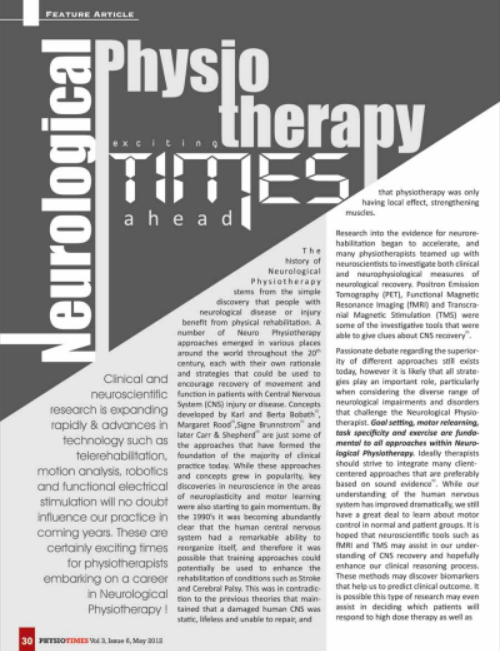
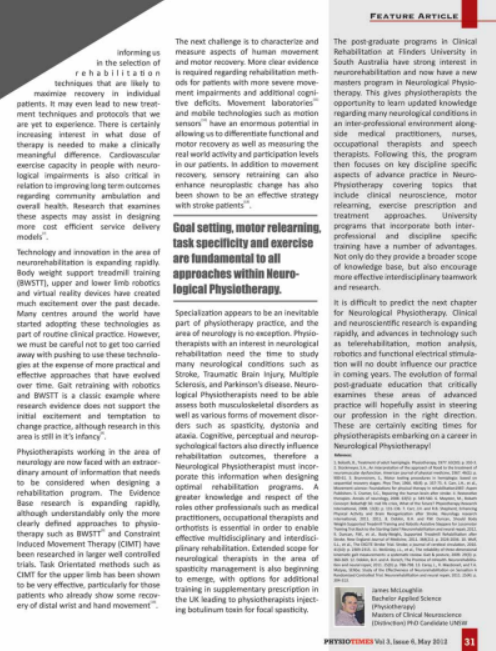
Physiotimes article 2012
Fourteen years later — and 20 years’ experience within a Neurological Physiotherapy Clinic, Advanced Neuro Rehab — I think it is worth asking: where has neurological physiotherapy arrived, and what have we learned along the way?
Technology: Evolution rather than revolution
One of the surprises of the past decade has been how little high-end rehabilitation technology has truly embedded into routine community practice. Robotics and electrical stimulation exist, but remain limited by cost, time, usability and uncertain real-world effectiveness. Too often, technology is developed without meaningful consultation with clinicians about the practical friction points of everyday care. I have had the pleasure of visiting clinics that provide access to many robotic gait and upper limb rehabilitation devices, including exoskeletons, - but these clinics remain quite scarce, and how technology is used alongside other rehabilitation skills remains a key ingredient for success. Other technologies such as Transcranial Magnetic Stimulation are still mainly found in research laboratories, with little clinical impact within the community.
"useful technology integrates into clinical reasoning — it does not replace it."
What has changed dramatically is our digital environment. Paper notes have disappeared. iPads, electronic health records and cloud-based clinical management systems are now standard. Artificial intelligence is entering report writing, communication and clinical organisation. Alongside this, we have selectively adopted tools that genuinely add value — eye tracking, Virtual Reality, slow-motion video analysis, wearable devices, digital outcome measure tracking, applications to support motivation, adherence and compliance, alongside long-standing equipment such as treadmills, body-weight support and exercise bikes.
The lesson has been clear: useful technology integrates into clinical reasoning — it does not replace it. I hope future technology companies broaden their research by engaging with more experience clinicians and patients to truly understand how technology can improve and enhance treatments and clinical practice in more usable and cost-efficient ways.
An expanding scope of practice
Interest in both neurological and vestibular rehabilitation has grown substantially. At the same time, the boundaries between neurological, musculoskeletal and sports physiotherapy have blurred. At ANR we have worked alongside musculoskeletal and sports colleagues for over a decade where we have gained a realisation and respect for different fields of practice. The overlaps are obvious - we all help manage balance, osteoarthritis, motor control, tendinopathies, muscle strains, ligaments strains, mental health and chronic pains. However, it's the cross pollination of ideas that drives interest and innovation.
We have managed presentations that defy simple labels —vestibular migraine, Postural Orthostatic Tachycardia Syndrome (POTS), Functional Neurological Disorder (FND), and Persistent Postural-Perceptual Dizziness (PPPD) have all been re-labelled over the past 20 years! Treatment methods have gone through trends and fads, ideological debates have come and gone (and are sometimes recycled again!), while knowledge, evidence and practical experience continues to improve our effectiveness. Many academics believe that clinical practice is slow to evolve with evidence, but 20 years on, I know for a fact this is not the case in community-based neurological physiotherapy!
"This breadth demands depth — and reinforces the importance of postgraduate education and lifelong learning."
In Australia, neurological physiotherapists work as first-contact practitioners. Patients can arrive without referral, diagnosis or history, presenting with anything from stroke to ataxia to vestibular neuritis. This breadth demands depth — and reinforces the importance of postgraduate education and lifelong learning. Understandably, there is a natural tension between generalist and specialist models of care. On one hand we need general physiotherapists to have some skills in neurology and vestibular practice, while we also need specialist physiotherapists to refer to for more advanced diagnostic and treatment capabilities. This is why I remain involved in education at both levels, professional development for rural physiotherapists and general physiotherapists as well as advanced practice training in neurological and vestibular practice.
Education as clinical infrastructure
One of the strongest lessons from 20 years of practice is that expertise is not static. In 2025 alone, ANR delivered 307 internal, professional development sessions to staff! — covering guidelines, research updates, case discussions, new technologies, mentoring and leadership. This does not include extensive external training course and webinars.
"Confidence fluctuates with exposure; education must respond accordingly."
We actively encourage change. Our clinical protocols evolve continuously. For example, our BPPV management guide has been revised ten times in five years, driven not by dogma but by a commitment to improving outcomes and patient experience.
We also developed a staff competency and confidence framework that recognises both skill acquisition and skill decay. Confidence fluctuates with exposure; education must respond accordingly. This approach has influenced our research activity and our teaching programs in vestibular rehabilitation, concussion and multiple sclerosis that have been utilised internationally.
Research and reality
Research in neurological rehabilitation has advanced rapidly, but its translation into practice has been uneven. Some evidence has reshaped care. Much has confirmed what experienced clinicians were already doing intuitively.
This is not arrogance — it reflects the historical difficulty of designing rehabilitation studies in complex neurological populations. Clinical reasoning matures faster than research infrastructure. The current challenge is not just evidence generation, but evidence integration: how to adapt research findings to the variability of real people, with multiple comorbidities, of different ages and in real communities with variable accessibility to physiotherapy.
A shifting healthcare landscape
"Advocacy is now more important than evidence."
With neurological conditions now recognised by the WHO as the leading cause of disability worldwide, neurological physiotherapy has become more visible — but not necessarily more secure. 3 billion people live with a neurological condition worldwide, and for those living with other conditions, brain functions are still very much part of a paradigm shift in care, from menopause to mental health, chronic pain to elite athletes – everyone is now thinking about brain health.
In Australia, the NDIS has reframed disability in bureaucratic terms that struggle to accommodate health complexity. Neurological physiotherapy is hidden within broader therapy services despite its diagnostic, adaptive and preventative role. Extracting “health” from disability care risks long-term cost and harm.
This is just one reason why the profession must now engage with leadership and policy, not just clinical excellence. Advocacy is now more important than evidence.
Still part of a team
Despite its growth, neurological physiotherapy remains one element of a multidisciplinary system. Effective care depends on relationships with GPs, neurologists, neurosurgeons, ENT specialists, psychologists, neuropsychologists, orthotists, speech pathologists, occupational therapists and exercise physiologists. Relationships and respect takes time, so its worth finding the time to mix and mingle with all professionals whenever you get the chance.
Most of these professionals’ work across different organisations, usually not under one roof. Coordination remains fragile. Fragmentation is likely to persist — making communication, respect and shared understanding ever more important. Improved digital monitoring with the ability to share consented clinical data between health professionals is potentially very exciting, while social media, online platforms and AI are accelerating knowledge dissemination at lightning speeds.
What 20 years at Advanced Neuro Rehab has taught us
Twenty years of community neurological practice teaches humility, adaptability, and the value of education. Over this time several truths stand out:
Technology helps, but clinical reasoning leads
Education is not optional — it is infrastructure
Labels change faster than diseases
Research informs practice, but practice shapes relevance
Multidisciplinary care is essential, but rarely seamless
Neurological physiotherapy must now engage with policy, not just patients
Most importantly, neurological physiotherapy has matured into a profession that operates at the intersection of movement, behaviour, cognition and health systems. Its future will depend not only on science, but on its ability to adapt, communicate and advocate.
At Advanced Neuro Rehab, our experience is not universal — but it offers a lived example of what sustained community neurological practice can become when education, reflection and care are held together over time.
And perhaps that is the greatest lesson of all: neurological physiotherapy is no longer emerging. It is established — and its next evolution will be defined as much by leadership as by knowledge.
Associate Professor James McLoughlin
Director, Advanced Neuro Rehab
Chief Academic Officer, Your Brain Health
Stay connected with news and updates!
Join our mailing list to receive the latest news and updates from our team.
Don't worry, your information will not be shared.
We hate SPAM. We will never sell your information, for any reason.
